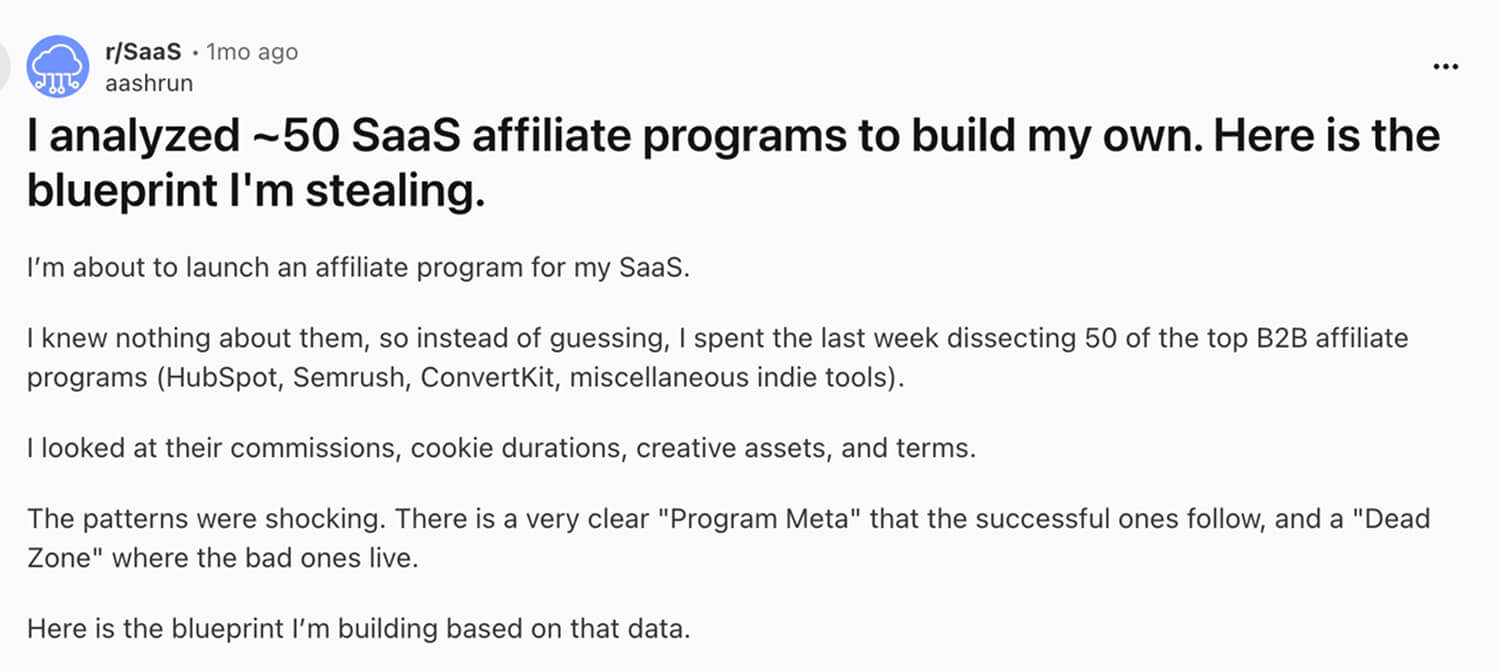
A SaaS founder on Reddit recently posted a breakdown of 50 SaaS affiliate programs. They dissected commission structures, cookie durations, creative assets, and more. What they found was a clear pattern: successful programs follow a specific affiliate program blueprint, while those that don't tend to stall.
What the Reddit post doesn't cover is what that affiliate program blueprint looks like when you actually have to execute it. For instance, when you're a bootstrapped SaaS that deliberately decided not to build a marketing department, or a SaaS company trying to break through in a crowded paid landscape. The affiliate program structure may be similar, but the implementation isn't.
Three Rewardful customers — beehiiv, Huntr, and getimg.ai — all run programs built on a similar SaaS affiliate program structure. Here's how they got there from different starting points and what their experiences reveal about the SaaS affiliate program structure that actually works.
The SaaS Affiliate Program Structure That Is Proven to Work
Before getting into how each SaaS company executes its affiliate program setup, it's worth naming the framework clearly.
Based on the Reddit post, a high-performing SaaS affiliate program has five elements:
- A recurring commission rate high enough to align affiliate incentives with retention (30% is the established benchmark).
- A cookie window that matches your sales cycle (90 days for most B2B SaaS).
- A partner kit that gives affiliates what they need to actually promote you.
- A direct recruitment strategy that prioritizes quality over volume.
- An infrastructure that handles tracking, fraud, and payouts without manual intervention.
Each of these exists for a reason. Together, they determine whether your affiliate program generates compounding revenue or quietly flatlines.
Affiliate Commission Structure: Align Incentives With Retention, Not Just Acquisition
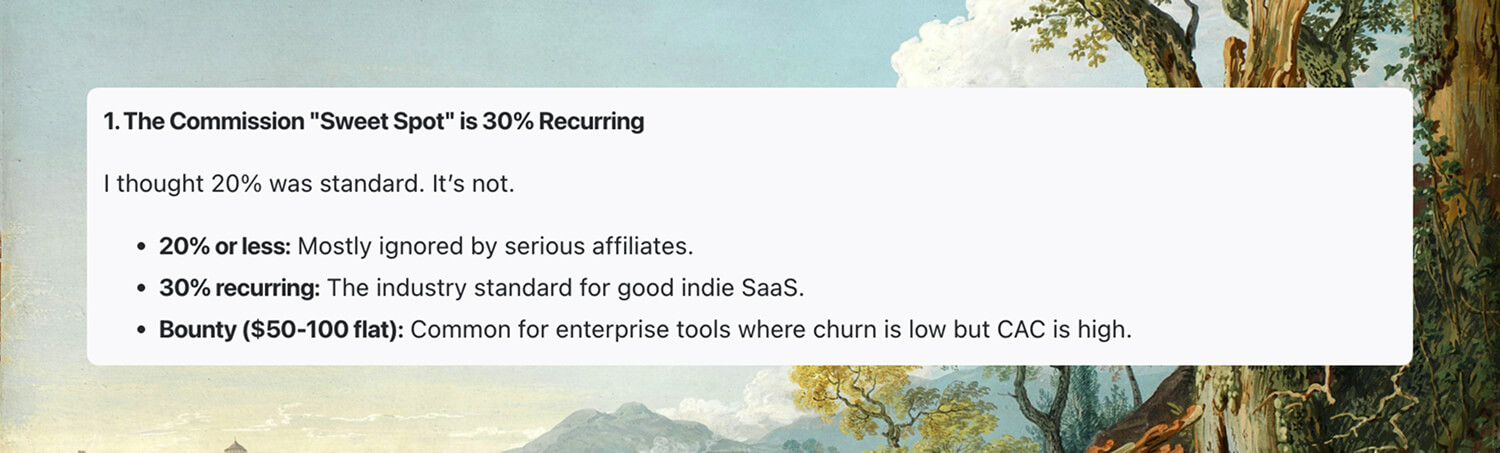
The Reddit analysis identified 30% recurring commission as a benchmark, but the reasoning matters more than the number. A recurring affiliate commission structure ties payouts directly to customer retention.
If an affiliate sends low-quality users who churn in month one, their earnings stop. If they refer customers who stay and expand, they continue earning over time. This turns commission into a built-in quality filter, incentivizing affiliates to prioritize fit over volume.
getimg.ai applies this model in a highly competitive SaaS category. As an AI image generator, it faces rising customer acquisition costs across paid channels. Affiliate marketing offered an alternative: trusted distribution through creators and partners who already reach their ideal audience.
The outcome is measurable. getimg.ai’s affiliate program now contributes 15–20% of monthly recurring revenue. What looks like a “generous” affiliate commission rate is actually a strategic lever that aligns partner incentives with long-term revenue, not just signups.
See how getimg.ai sets their affiliate program up on Rewardful.
beehiiv arrived at the same affiliate program structure from a different starting point: cost control. When evaluating affiliate management software, the pricing model directly impacted the total cost of running their affiliate channel.
Affiliate platforms like PartnerStack take a percentage of affiliate revenue, while Impact’s enterprise pricing didn’t align with beehiiv’s stage of growth. In contrast, Rewardful’s flat subscription model meant commissions went fully to affiliates—without an additional platform cut layered on top.
That structural difference matters more over time. As the affiliate program scales, revenue-share fees compound, increasing the effective cost of acquisition. With a flat pricing model, beehiiv could maintain a predictable affiliate commission structure while preserving margins. beehiiv's affiliate program now generates 12–14% of MRR, on track for $1.2–1.5 million annually.


Affiliate Onboarding Process: What a Partner Kit Should Include

The Reddit post named this one the "lazy tax." They signed up for 10 affiliate programs to see what the onboarding experience looked like. Seven gave them a link. Three gave them a partner kit: email templates, banners, a Notion doc of selling points, and a short Loom walkthrough of the product. The ones worth promoting were obvious.
The underlying point is straightforward: affiliates are running their business by promoting your SaaS product. If positioning your product requires them to figure out the messaging themselves, write their own copy from scratch, and hunt down screenshots of an interface they've never used, most will deprioritize it and eventually drop it. The easier you make their job, the more likely they are to actually do it.
Huntr built their entire growth strategy around this principle. They run a small team and made a deliberate choice not to build a marketing department. Instead, they focused on partnerships with people who already had reach and trust in career-focused spaces — LinkedIn creators, coaches, and resume advisors. Those partners didn't need Huntr to do their marketing for them. But they did need to feel like the program was professional and the setup was worth their time.
When Huntr recently onboarded a LinkedIn creator with nearly a million followers, her reaction was: "That was so easy." That's the goal. A frictionless onboarding experience isn't a nice-to-have — it's what determines whether a partner becomes a long-term advocate or promotes you twice and moves on.
Find out more about how Huntr runs their AI affiliate program with Rewardful.
Affiliate Recruitment Strategy: Direct Outreach Before You Recruit Publicly
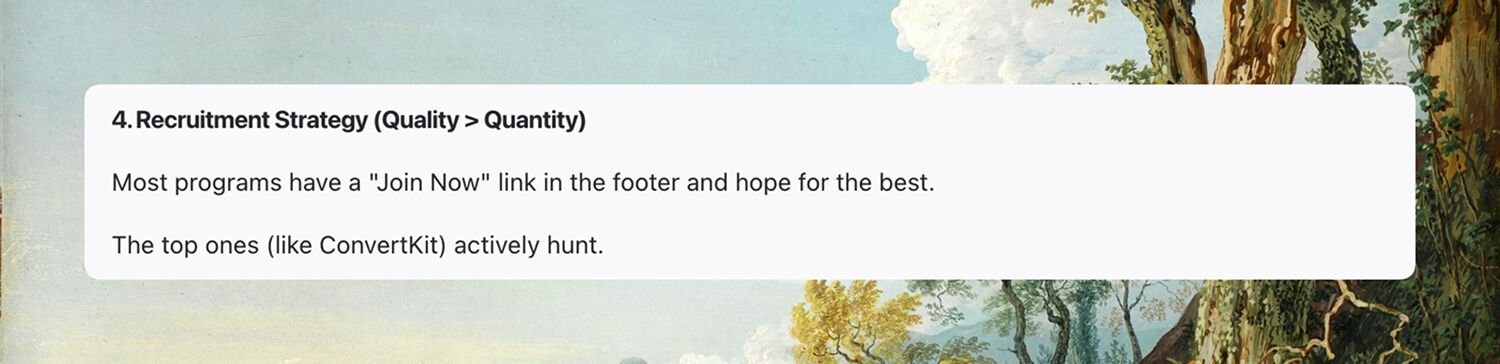
Most affiliate programs have a "Join Our Program" page buried in the footer and promoted on LinkedIn when there's nothing else to post. The Reddit analysis found that the top-performing programs don't wait. They actively recruit before launch, targeting people who have already written about their niche and offering an invite-only tier with better terms for early partners. The logic: ten partners who genuinely write content are worth more than a hundred coupon sites.
getimg.ai applied this at scale. They didn't launch with thousands of affiliates. Instead, they built toward that number by starting with the same thing every program starts with: direct outreach to people who already had the right audience, and giving those early partners something real to work with. The volume came later. The foundation was getting the right early partners in place first — people who believed in the product and had genuine reach with the ICP.
The recruitment strategy doesn't change as your program grows. What changes is the infrastructure supporting it.
Affiliate Management Software: What to Look for to Simplify Affiliate Payout
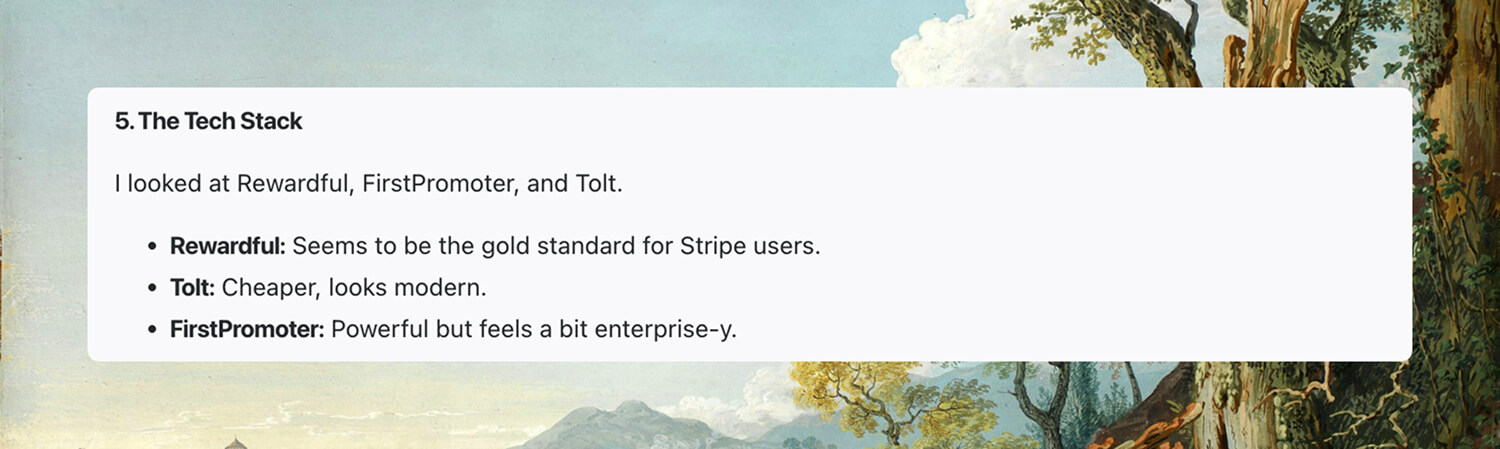
The Reddit post raised the software question directly: between Rewardful, FirstPromoter, or Tolt, which affiliate tool should they choose? They want affiliate software that simplifies affiliate payouts. That's the right framing, but it understates the problem.
Manual affiliate tracking creates friction that compounds. Affiliates email asking what they earned. Finance reconciles Stripe exports against a spreadsheet. Engineering gets pulled in to debug attribution. None of these is catastrophic on its own, but together they consume the time and trust an affiliate program runs on.
beehiiv specifically cites Rewardful's fraud detection as one of its most-used features. Self-referral fraud is a real and common problem in affiliate programs. Catching it manually is slow and error-prone. Automated detection with instant notifications lets beehiiv act quickly — the kind of operational detail that doesn't come up in commission rate conversations but determines how a program holds up at scale.
Read more on what beehiiv says about their experience using Rewardful.
Huntr's most-used feature is mass PayPal payouts: export a CSV, upload to PayPal, everyone gets paid on time. For a team that built a program on the explicit premise of not building a marketing department, eliminating manual payout work isn't a convenience — it's a requirement.
getimg.ai relies on the same capability at a different scale: Rewardful’s mass payouts through PayPal and Wise across a network of thousands of affiliates, processed in a single action.
The payout infrastructure isn't a flashy feature. But it's what keeps affiliates showing up month after month.
Build Your Affiliate Program on Infrastructure That Scales With You
The blueprint from that Reddit analysis — 30% recurring, a real partner kit, direct recruitment, clean tracking and payouts — works because each element reinforces the others.
beehiiv, Huntr, and getimg.ai all built programs on this foundation. They got there from different places and made it work within very different operational realities. What they share is the same underlying structure and the same platform running it — Rewardful.
If you're launching an affiliate program or running one that takes more work than it should, try Rewardful free for 14 days. No credit card required. Connect your Stripe account, set your commission structure, and see how it runs.