
Choosing the wrong affiliate marketing tool for your SaaS business usually leads to the following headaches: restrictive affiliate revenue caps, rigid commission structures, or clunky affiliate payout processes that alienate your best partners.
Our team conducted an in-depth evaluation of the leading affiliate software. We reviewed public documentation, analyzed real user feedback, and evaluated the core features, limitations, and pricing models of FirstPromoter, Cello, and Reditus.
As a team that lives and breathes SaaS growth, we know exactly what it takes to manage affiliate programs day-to-day. Based on our industry experience and architecture review, these three tools are actually built for entirely different growth strategies.
Here is our analysis of how FirstPromoter, Cello, and Reditus operate, where each shines, and how to choose the right fit for your business.
FirstPromoter vs. Cello vs. Reditus: Quick Comparison
FirstPromoter
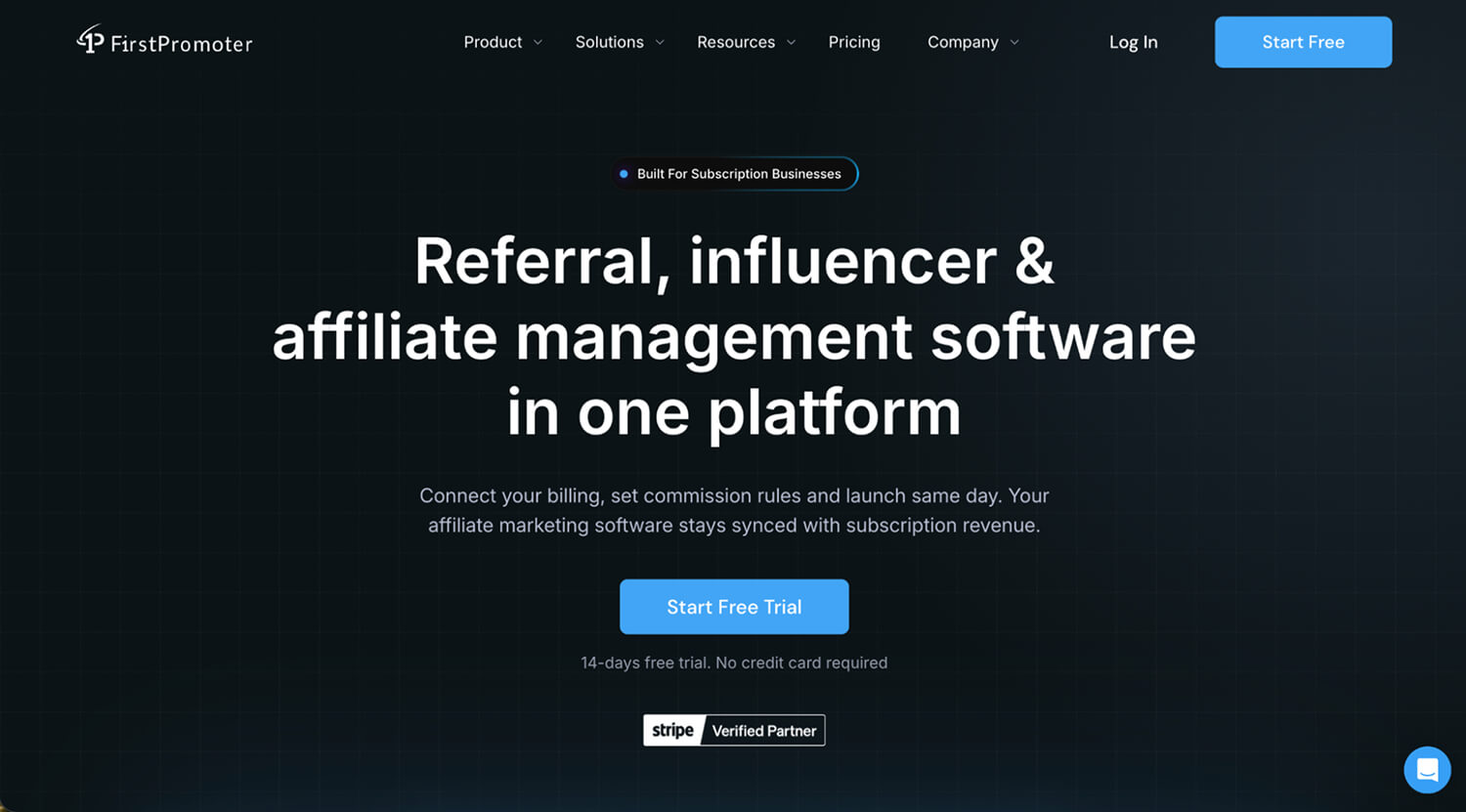
FirstPromoter tracks affiliates, manages commissions, and connects to your billing stack. It supports Stripe, Chargebee, Paddle, Recurly, and Braintree. You get link tracking, coupon codes, a branded affiliate dashboard, PayPal and Wise payouts, and fraud prevention tools. FirstPromoter is great for a team that wants to launch their first or basic affiliate program.
FirstPromoter Unique Selling Points
- Direct integration with Stripe, Paddle, Chargebee, Recurly, and Braintree
- Link and coupon code tracking
- Branded affiliate dashboard
- PayPal and Wise payouts
- Two-sided rewards
- Multi-tier commissions on higher plans
- Fraud prevention tools
FirstPromoter Pros and Cons
Pros of FirstPromoter
- Fast to set up, especially for Stripe-first teams
- Broad payment processor support
- Reliable recurring commission tracking
- 14-day free trial, no credit card required
Cons of FirstPromoter
- Starter plan capped at $5,000/month in affiliate revenue, 2 campaigns
- Pricing tiers unchanged while the market has kept moving
- Reporting functionality is limited to day-to-day tracking (source: Reddit)
- Less flexible for complex commission structures or multi-campaign programs
FirstPromoter Pricing
- Starter: $49/month (up to $5,000/month from affiliates, 1,000 affiliates, 2 campaigns)
- Business: $99/month (up to $15,000/month from affiliates, unlimited affiliates and campaigns)
- Enterprise: $149+/month (over $30,000/month from affiliates)
No transaction fees on any plan.
Cello
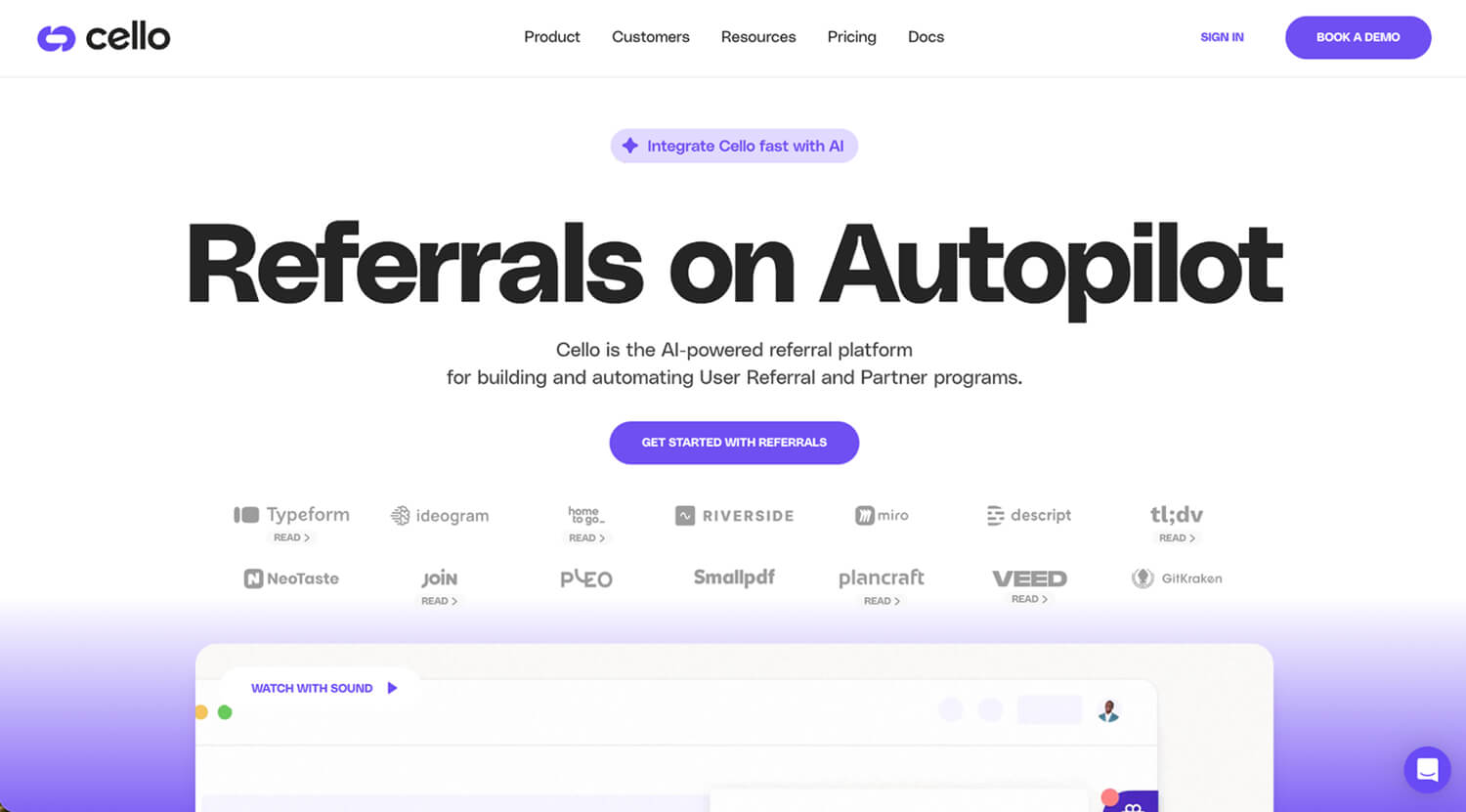
Cello markets itself as a referral and partner platform. But the product was built for user referrals (inside your app) and that’s where it shines bright.
What Cello does well: you embed a referral widget into your authenticated product, and your existing users can refer friends without ever leaving the app. Attribution is automatic. Rewards are handled. For PLG companies where the user base is a growth channel waiting to be activated, it’s a clean solution.
What it doesn’t do well: external affiliate programs. Based on our observation, there’s no coupon code support. The partner-facing experience is relatively thin.
There are also two hard constraints. First, to install Cello you need frontend integration to your app or website and user authentication. Second, there’s a 5% transaction fee on partner referral payouts, on top of the subscription.
If you want to turn your existing SaaS product users into referrers, Cello is worth a serious look. However, if you want to recruit and manage independent affiliates (influencers, podcasters, newsletter writers, or agencies) it has some limitations.
Cello Unique Selling Points
- In-product referral widget embedded in your app
- User referrals and partner referrals from one platform
- Implementation typically a few hours with minimal dev resource
- Automated KYC, compliance, and fraud detection
- Performance-based pricing tied to referral ARR
Cello Pros and Cons
Pros of Cello
- Purpose-built for in-product, user-led referral growth
- Free to get started; costs scale with results
- Fast setup for product-led teams with an authenticated app
- Strong compliance and payout automation for user referrals
Cons of Cello
- Requires a logged-in web or mobile experience to function
- Affiliate backend too limited for affiliate programs that focus on external affiliate recruitment
- No affiliate coupon code support (that we’re aware of)
- G2 reviewers ware asking for more customizability features within the product, such as for landing pages, and filtering features.
Cello Pricing
- Free plan: up to €5k referral ARR
- Grow: €200/month (up to €50k referral ARR)
- Scale: €750/month (up to €100k referral ARR)
- Enterprise: custom
5% transaction fee applies to partner referral payouts.
Reditus
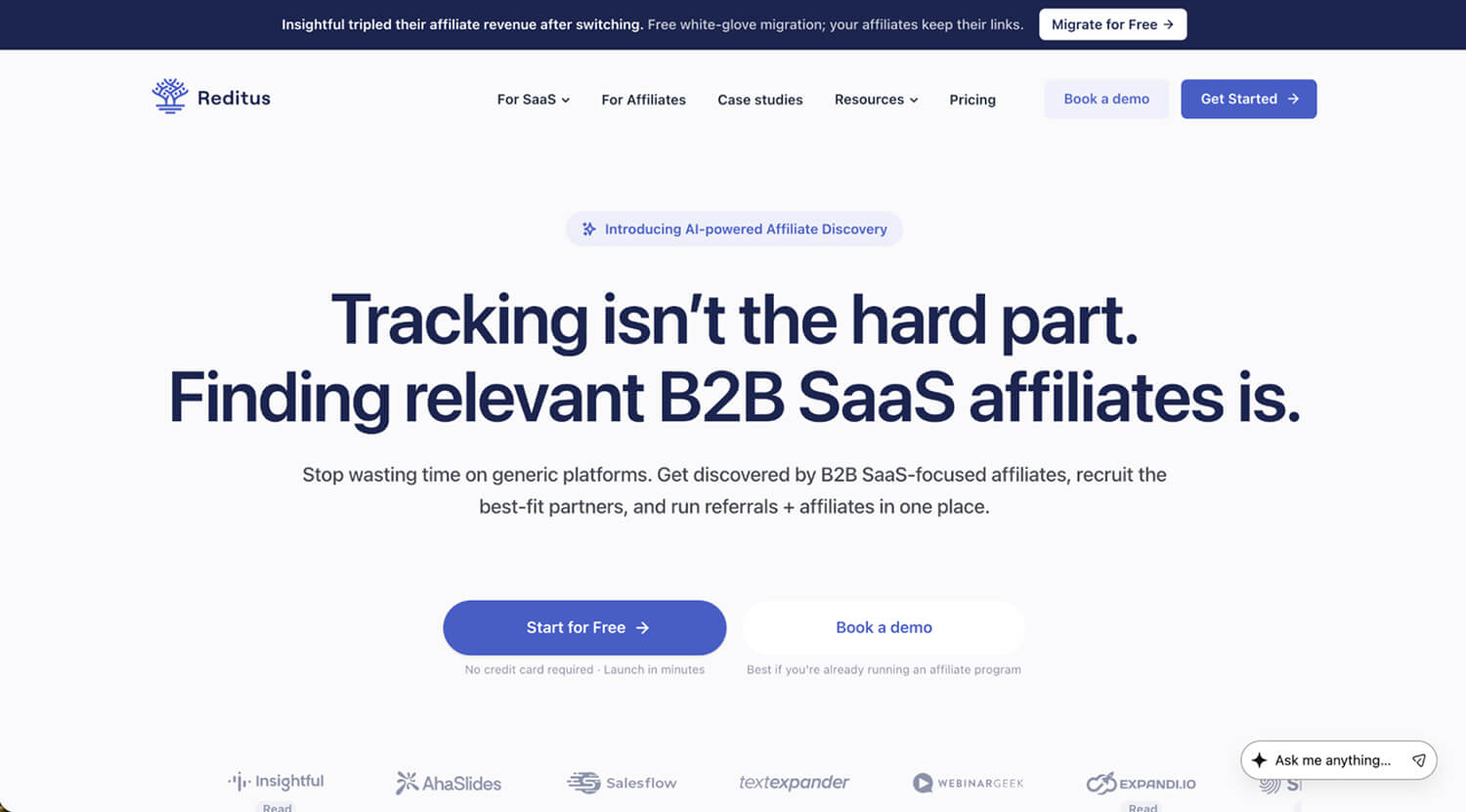
Reditus is one of the affiliate software that offers affiliate marketplace. When we went inside its marketplace, it has 25,000+ B2B SaaS affiliates on the platform who are actively browsing programs to join. If you’re launching an affiliate program from scratch and has no desire to recruit your partners manually, Reditus marketplace is a great shortcut compared to cold outreach.
But there's a catch: the marketplace is only accessible on the $239/month Scale Up plan. The free plan (up to $1,000/month in affiliate MRR) is enough to test how Reditus can support your affiliate marketing program. But if the marketplace is why you’re considering Reditus, that’s the plan you’re budgeting for.
Now, if you still want to do manual cold affiliate outreach, Reditus comes with the recruitment fundamentals: custom sign-up page, tracking, commission management, CRM integrations. But looking at how Reditus is built and marketed, it seems that that the platform is built around affiliate discovery first, and partner management second.
Reditus Unique Selling Points
- Marketplace of 25,000+ B2B SaaS affiliates
- AI affiliate recruitment feature for finding partners by industry
- Free plan available (up to $12k ARR via in-app referrals)
- Custom affiliate sign-up page and dashboard
- Integrations with Stripe, Paddle Billing, and major CRMs
- White-glove migration support on Growth and Scale Up plans
Reditus Pros and Cons
Pros of Reditus
- Marketplace access is a real head start for affiliate discovery
- Free plan makes it low-risk to test
- Built exclusively for B2B SaaS
- CRM integrations useful for larger sales-led teams
Cons of Reditus
- MRR-based pricing rises as the program grows
- Management tooling can be limited for more complex affiliate program structures
- More of discovery-first affiliate software
- A user left a G2 review, saying they wished to have more detail reporting
Reditus Pricing
- Free: up to $1,000 MRR from affiliates
- Starter: $71/month (up to $5,000 MRR)
- Growth: $119/month (up to $10,000 MRR)
- Scale Up: $239/month (up to $20,000 MRR)
Note: Reditus marketplace listing available on Scale Up plan only.
FirstPromoter vs. Cello vs. Reditus Pricing Side By Side
FirstPromoter vs. Cello vs. Reditus: Which Affiliate Tool Should You Choose?
After reviewing FirstPromoter, Cello, and Reditus, we come to a conclusion that each tool has different strengths and weaknesses, and therefore, is best suited for a different affiliate marketing approach.
- If you’re looking for an affiliate tool that offers the fundamental affiliate management features, FirstPromoter is a great option.
- If you’re looking for affiliate software that allows you to promote partner program within your product, consider Cello.
- If you’re looking for affiliate software that comes with a marketplace, try Reditus.
Haven’t found an affiliate tool that matches your needs? Rewardful can be the SaaS affiliate software that you’re looking for!
Rewardful: An Alternative to FirstPromoter, Cello, or Reditus

Rewardful is built for SaaS affiliate programs, known for its smooth Stripe integration, easy affiliate payment (through Managed Payouts), multi affiliate campaigns management, and anti-fraud system.
SaaS companies and founders that switch from other affiliate platforms are satisfied with how Rewardful supports their affiliate marketing needs, from accurate link and coupon code affiliate tracking to automated refund and more.
Here are more reasons why SaaS businesses choose Rewardful over FirstPromoter, Cello, or Reditus:
- Built for subscriptions
Rewardful’s two-way Stripe sync adjusts commissions automatically when customers upgrade, downgrade, or cancel. See how Rewardful handles subscription billing.
- Links and coupon codes
Affiliates can promote via tracked links or coupon codes — useful for podcasters, YouTubers, and newsletters where a link isn’t practical.
- Easy setup and low learning curve
Single-click Stripe connection, no engineering required.
- Multiple affiliate payout options
Manual payouts, PayPal and Wise mass payouts, or Managed Payouts — where Rewardful handles tax forms, invoicing, and transfers across multiple countries.
- Affordable and transparent pricing
Plans start at $49/month, scale with affiliate-generated revenue, no transaction fees. Full breakdown on the Rewardful pricing page. For a direct comparison of how transaction fees stack up across tools, see affiliate software transaction fees.
- Trusted and loved by SaaS companies
Clay, Taplio, Replit, Podia, and beehiiv are some of the happy users of Rewardful. Even Podia doubled their affiliate revenue in just 5 months after switching to Rewardful. Read Podia’s success story or watch the video below to find out more.
How Rewardful Compares to FirstPromoter, Cello, and Reditus
Curious to see exactly how Rewardful stacks up when managing your program day-to-day? While all four platforms help you run affiliate campaigns, their underlying architecture and tracking logic are built for different SaaS growth strategies.
Here is a deeper look at the technical and operational differences between Rewardful and these three platforms:
Rewardful vs. FirstPromoter: Seamless Subscription Sync vs. Plan Caps
FirstPromoter severely limits its $49/month starter plan, capping your program at just 2 campaigns and $5,000/month in affiliate revenue. If you succeed, you are forced into an expensive plan change. Rewardful gives you unlimited campaigns on all plans, letting you scale your program freely without hitting restrictive structural walls.
See how Rewardful matches up against FirstPromoter in our side-by-side Rewardful vs. FirstPromoter comparison.
Rewardful vs. Cello: External Influencers vs. In-App User Widgets
While Cello focuses on activating your existing user base from inside your app, Rewardful unlocks external growth channels. It gives you the infrastructure to scale a traditional affiliate program with outside partners like industry influencers, bloggers, and agency partners.
Deciding between user referrals and external affiliates? Compare Rewardful vs. Cello.
Rewardful vs. Reditus: 0% Fee vs. Extra Charge
Reditus charges you based on a percentage of your affiliate MRR, meaning they take a bigger cut of your revenue as your program grows. With Rewardful, you don’t have to pay extra for your success. It offers predictable, transparent, flat-rate pricing that protects your profit margins as you scale.
Learn how Rewardful stack up against Reditus in our deep-dive comparison of Rewardful vs. Reditus.
FirstPromoter vs. Cello vs. Reditus: Choose The Affiliate Tool That Aligns with Your Growth Strategy
Ultimately, choosing between these platforms comes down to how you plan to acquire your partners. If you want to tap into an existing pool of B2B SaaS publishers and don't mind paying a premium to access it, Reditus provides a built-in discovery engine. If your primary goal is to turn your active, logged-in software users into brand ambassadors via a native, in-app widget, Cello is built specifically for that workflow.
However, if your goal is to build an independent, highly scalable affiliate channel using external partners like influencers, bloggers, and agencies, you need a dedicated management platform. While FirstPromoter offers traditional tracking, its restrictive plan caps can penalize early success. Rewardful eliminates those arbitrary walls—delivering a deep, two-way subscription sync engine with Stripe, unlimited campaigns, and flat-rate pricing designed to protect your profit margins as you scale.
Try out Rewardful today, and tell us what you think!
Other affiliate tool reviews that may interest you:
- Dub vs. Tolt vs. Trackdesk: What’s the Best Affiliate Software for SaaS?
- 6 Best Affiliate Software for SaaS That Integrate with PayPal
- The Best Affiliate Marketing Software for Online Communities
FAQs on FirstPromoter vs. Cello vs. Reditus
What’s the best affiliate software for SaaS AI companies?
Rewardful is one of the best affiliate software for SaaS AI companies. Rewardful tracks recurring commissions, handles refunds automatically, and makes it easy for AI SaaS businesses to pay their international affiliates through Managed Payout system. See our roundup of the best affiliate software for AI SaaS companies to learn more.
Is Rewardful a good FirstPromoter alternative?
Rewardful is a strong FirstPromoter alternative, especially once your affiliate program outgrows two campaigns or $5,000/month in affiliate revenue. Both integrate with Stripe, offer excellent affiliate tracking, and payout management.
How does Cello differ from a “traditional” affiliate platform like Rewardful?
Cello excels at in-product referral and partnership marketing, allowing you to recruit your product users to your brand ambassador. Rewardful, on the other hand, gives you the tools you need to recruit affiliates externally and offers affiliate links and coupon codes features.
Can Rewardful replace Reditus for B2B SaaS affiliate programs?
For most teams, yes. Reditus’s marketplace is its main differentiator — Rewardful doesn’t have one yet (coming soon). If affiliate discovery is your primary problem, Reditus has the head start. For running a program day-to-day, Rewardful is an excellent alternative to Reditus for B2B SaaS affiliate programs.