Most affiliate managers are experimenting with AI right now for more efficient affiliate management, but few have a clear boundary for where it helps versus where it breaks things.
The market isn't lacking AI tools. What it’s lacking is honest, operator-level clarity. Which affiliate management tasks deserve a permanent spot in your AI tech stack? Which ones are high-risk distractions? And where do human judgment and relationship-building still reign supreme?
In this practical guide to AI affiliate program management, we’re cutting through the noise. We break down what AI automates reliably, where human oversight is non-negotiable, and how to split your workload without sacrificing partner trust, especially for SaaS affiliate programs.
Is AI the Fix for Better Affiliate Management, or Just the Shiny Option?
Before you build or buy AI tools to manage your affiliates, spend five minutes on one question: what specific problem are you trying to solve?
In our daily work consulting with scaling SaaS brands, we regularly see affiliate managers deploying AI to fix processes that weren't broken in the first place. For instance, if your affiliate payout process takes 30 minutes a month and reconciles without errors, likely, it does not need an AI layer. Swapping a zero-defect workflow for an AI version yields the exact same output—just with added API latency, model hallucinations, and extra software bills.
So, here’s a simple rule before you adopt any AI workflow for your affiliate program: define the structural bottleneck.
Unless you have a serious issue in your affiliate program management that is impacting growth long-term, forcing AI into the loop creates unnecessary friction. For example, if you know you want to double your affiliate numbers—going from 40 affiliates to 400 next year—using AI to automate affiliate recruitment screening is smart.
But keep in mind that many affiliate marketing growth bottlenecks have better answers that involve no AI at all: better human workflows, structuring clearer commission tiers for long-term retention, updated partner enablement assets, or a stronger strategy. AI deserves a seat at the table, but it shouldn't skip the queue.
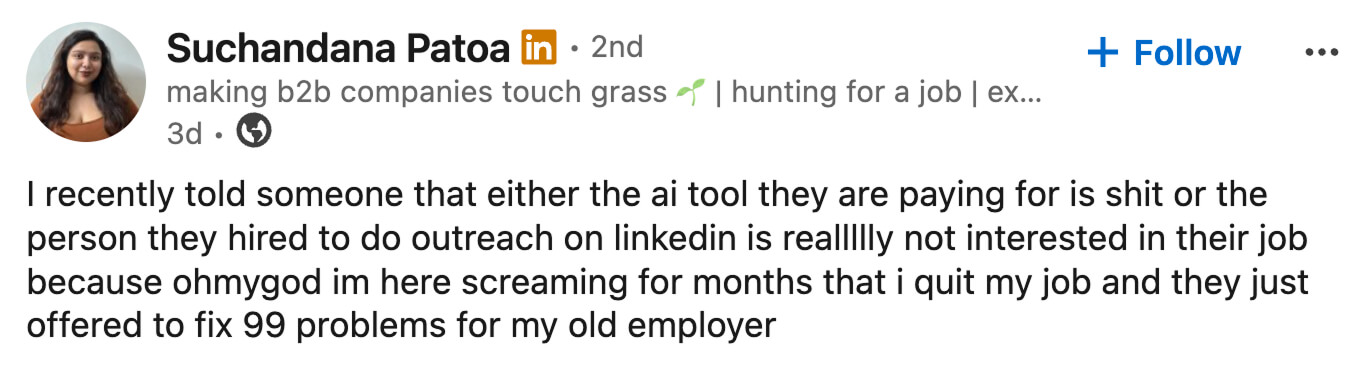
If you need proof of what happens when AI skips basic human oversight, just look at how creators and prospects react to automated outreach today. Just like this LinkedIn post shows, relying on unvetted AI automation is an easy way to burn trust before a relationship even starts.
What AI Does Reasonably Well in Affiliate Management Today
Affiliate recruitment research, campaign reporting, affiliate fraud detection, churn alerts: these are the usual suspects on every AI-for-affiliates list. Every one of them already has mature, purpose-built affiliate program automation SaaS behind it (often with an LLM already built in). Duct-taping a raw ChatGPT prompt to a job that dedicated software handles natively for $49 a month is a waste of everyone's time and resources.
Where AI for affiliate managers delivers true leverage is in unstructured, time-dense territory: the high-volume reading, pattern recognition, and drafting where a machine can execute the first pass in seconds without anyone's feelings getting hurt. Here are some examples of smart AI usage in affiliate marketing management.
1. Automating Affiliate Recruitment: Screening the Application Pile
Any program with a public signup form attracts link farms, coupon scrapers, and applicants whose "website" is a crypto wallet. Having processed millions of partner signups across Rewardful ourselves, we know that recruiting high-quality SaaS affiliates requires separating noise from value—and manually skimming thousands of applications is how a good applicant gets accidentally rejected. AI can instantly sort the pile into obvious spam, obvious fits, and a short review stack that deserves your full human attention.
2. Affiliate Asset Management: Auditing Live Affiliate Content
Past a hundred partners, nobody manually rereads what affiliates published last year. Wrong pricing, expired promo codes, and missing disclosure lines—someone needs to spot the outdated affiliate assets. Feeding AI your affiliate URLs and asking what's outdated or missing is verification work it happily handles across thousands of pages, and something you were never going to do quarterly by hand.
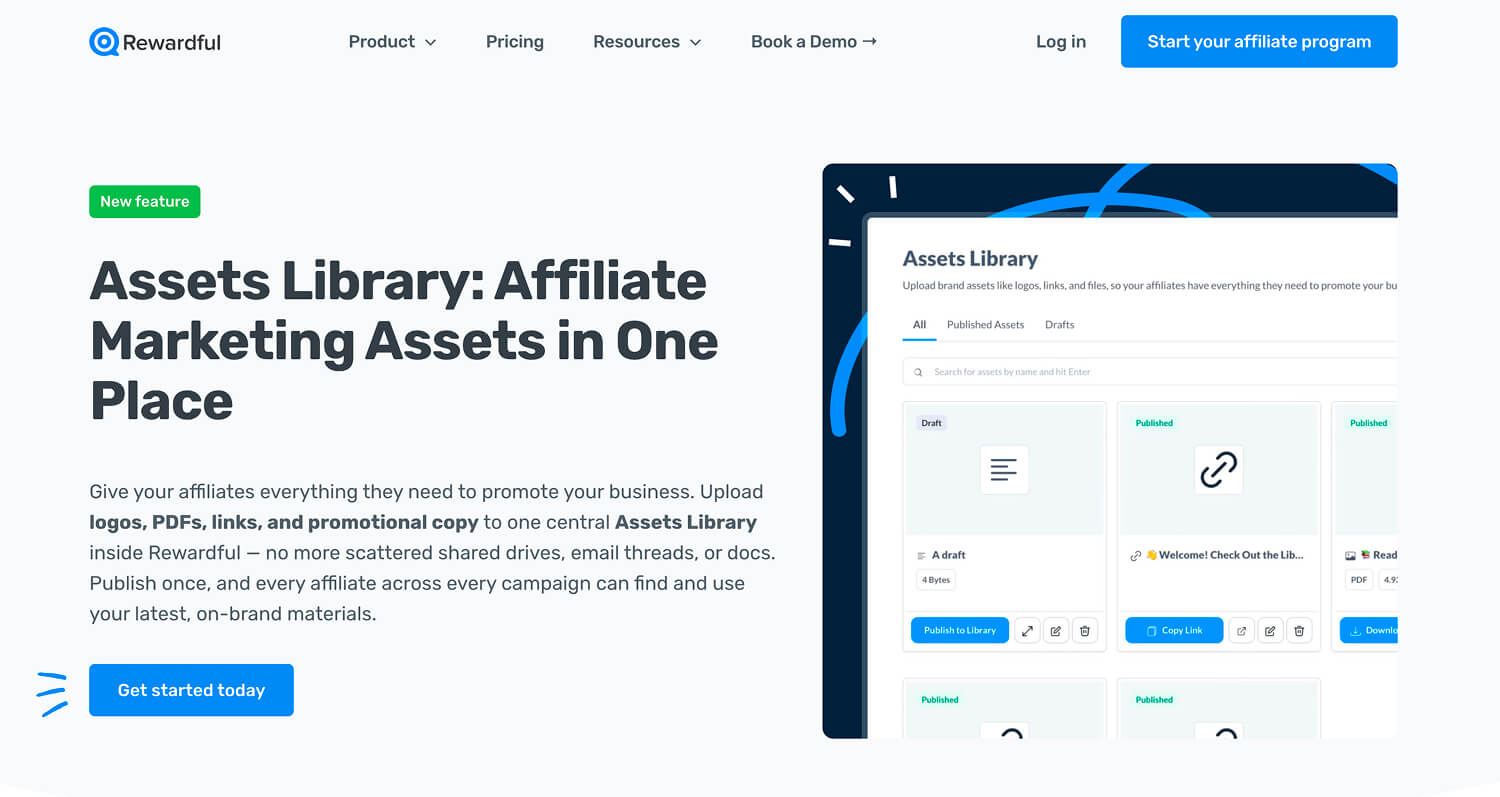
If you’re struggling to keep promotional materials updated across your network, Rewardful’s Asset Library solves this at the source. You can upload brand guidelines, approved copy, and media assets directly to your dashboard, ensuring your affiliates always have instant access to accurate, on-brand content.
3. Affiliate Onboarding: Mining Questions for Your Knowledge Base
Instead of guessing where new partners get stuck, feed six months of affiliate support chats and emails into an LLM. In our experience, AI can synthesize your top five recurring partner confusion points in an afternoon, giving you an exact blueprint for what to fix in your onboarding sequences.
4. Daily Program Management: Keeping the Promise Ledger
Commitments to partners pile up across email, Slack, and call notes: a bumped rate after fifty sales, an exclusive landing page, or a first look at the next launch. Forgetting one costs more goodwill than most fraud incidents. AI reading your threads and maintaining an automated who-was-promised-what list is unglamorous secretarial work, and precisely the kind that keeps your relationships intact.
5. Affiliate Relationship Building: Prepping Your Check-In Calls
The check-in call with affiliates itself stays human, but AI can make you significantly better prepared for it. Ten minutes beforehand, have an AI agent pull together what the partner published since you last spoke, how their numbers moved, and what you two discussed previously. Showing up informed reads as respect, and respect is the one thing machines can't produce.
Where Using AI to Manage Affiliates Still Fails
Where AI hits a wall is simple: scaling an affiliate program relies on real human relationships.
When analyzing the top 10% of revenue-generating programs on Rewardful, one constant emerges: top affiliates stay because they have built a genuine connection with your program manager over the years. They get quick answers when things break, issues get fixed before trust gets a scratch, and they know there's a real person behind the screen.
That human connection is precisely why models struggle when the stakes get personal. Here is where AI fails to deliver:
1. High-stakes negotiation
Striking a custom deal means reading a specific person: what they value, what you can afford, and what precedent this sets for the next twenty partners who hear about it. An AI model for an affiliate program can suggest static commission ranges all day long, but it can't read the room.
2. Borderline fraud calls
Automated affiliate fraud detection tools give you signals, and signals sometimes point at your best partner during a viral campaign. Automatically suspending a loyal affiliate on an unverified false positive costs far more than most minor fraud does. That final judgment call, and the accountability that comes with it, cannot be delegated to an algorithm.
Notice that these are precisely the tasks your revenue concentration depends on. Your top ten affiliates aren't just spreadsheet rows. They are human relationships driving the vast majority of your revenue.
How AI Automation Affects Affiliate Trust and Outreach Response Rates
Streamlining your affiliate management internal ops with AI is only half the picture — how that tech lands on your partners matters just as much. Creators and affiliate partners are increasingly selective about who they work with, and low-effort AI touchpoints are an easy way to get ignored.
Some creators state "no AI outreach" right in their bios, while others use more AI tools than you do and won't blink at yours. You'll only know which is which by paying attention, which is rather the point.
Treat AI usage as a values question, and weigh how it lands on every relationship you want to build. An obviously machine-written first touchpoint tells a creator precisely how much effort the partnership was worth to you. If explaining how something was generated would embarrass you, change how it's made. That rule predates AI and survives it just fine.
Free AI Tools Rewardful Built for Your Affiliate Program
We wouldn’t write all this advice without giving you something practical to use. Drawing on data from millions of tracking events and thousands of partner workflows, we built two AI tools specifically designed to help affiliate managers and SaaS solopreneurs make better strategic decisions. And they’re completely free.
In fact, we use this exact strategic framework and dataset to power Rewardful’s own affiliate program, so you’re getting the same insights we rely on to grow our own business.
1. The Affiliate Outreach Generator
This tool takes on the heavy lifting of recruitment research described above. Drop in your product URL, find creators in your niche, and get three outreach templates ready to personalize (a step you shouldn't skip—just like you still have to cook the steak your butcher sold you). You’ll get a cold email, a follow-up, and a LinkedIn DM ready for your personal touch.
Try the Affiliate Outreach Generator for free.
Want to see how it works first? Watch this short demo video:
2. Rewardful’s Free Claude Skill
This AI tool covers your high-level strategy questions. Install it in Claude and ask what a busy operator asks: What commission should I offer? How should I structure my tiers? Why do affiliates sign up and then do nothing?
Answers draw directly on Rewardful's battle-tested playbooks and data from thousands of SaaS programs—the exact same dataset we drew from when we analyzed 250 top Rewardful affiliate programs. It’s about as close as you’ll get to having an experienced affiliate strategist on retainer, at the bargain rate of zero dollars.
Install the free Rewardful Claude Skill to get instant strategy answers.
Curious to see it in action? Check out this sneak peek video:
The AI Affiliate Delegation Matrix: What to Automate, What to Keep
Looking for a quick framework to audit your AI affiliate management workflow? Here is the exact task split to help you scale your affiliate program without losing the human touch.
The Foundation for AI-Driven Affiliate Programs: Reliable Attribution
Ultimately, AI models, custom scripts, and LLM skills are only as effective as the data driving them. Automating affiliate recruitment screening, flagging for churn risk, or auditing affiliate content will only yield clear, reliable outputs if your underlying attribution, click logs, and conversion records are accurate. When your inputs are messy, AI simply accelerates bad decisions.
That foundational reliability is where Rewardful comes in. Whether you are building an affiliate program for an AI SaaS company or scaling an established software brand, Rewardful provides accurate affiliate tracking, automated commission management, and streamlined payouts that eliminate monthly reconciliation rituals.
Rewardful plans start at $49 per month, and you can test everything free for 14 days. Start your free trial to give your team and your AI assistants clean, trustworthy data to build on.
Looking for more strategic advice before getting started? Browse our full Affiliate Marketing Resources library anytime.