Your affiliate program is already shaping your AI visibility. The question is whether it's doing it well.
The content your affiliates publish (reviews, comparisons, tutorials, LinkedIn posts) is exactly what large language models (LLMs) draw on when generating product recommendations. What they say about your product, and how they say it, determines whether AI search recommends you or ignores you.
The problem is that most affiliate programs are optimized for the wrong output. Coupon aggregators, thin listicles, and generic "Top 7 SaaS Tools" roundups don't get cited by LLMs — and in my experience, they never did. What gets cited is opinionated, specific, first-hand content: the kind that shows the writer actually used the product, understands the use case, and has a point of view worth surfacing.
This isn't the affiliates' fault — it's a structural problem. Programs recruit broadly, reward any conversion equally, and hand partners a banner pack and a tracking link. If you want your affiliate program to support your AI visibility strategy, you have to build it around that goal from the start.
How Affiliate Content Shapes Your Brand AI Visibility
What your affiliates create, whether it's a blog review, a YouTube video, or a LinkedIn post, is part of the information pool AI platforms draw on when forming recommendations. This means your affiliates are actively shaping how AI search associates your brand with specific use cases, audiences, and problems.
If what they publish is accurate and specific, that works in your favor. If it's thin, generic, or misleading, it works against you — and unlike a bad ad, you can't pause it.
Common Poor Affiliate Content that Hurts Your AI Search Visibility
Not all affiliate content gets cited by LLMs. These are the patterns I see most often that actively hurt AI search visibility:
- Two-paragraph "reviews" where the product description is lifted verbatim from your homepage, with one sentence of editorializing bolted on at the end.
- Listicles with ten identical tool descriptions, each one clearly generated by AI.
- Black Friday roundups that are published in November and deindexed by February.
- Content built to capture a thin slice of search traffic and nothing else.
AI platforms don't cite that content. They synthesize material that shows perspective, specificity, and evidence that the writer actually used the product. A reviewer who can describe the exact feature you shipped, the point at which pricing scales, and the limitation that frustrated them in week two — that gets cited. A reviewer who paraphrased your G2 page in eighty words does not.
If you're seeing a lot of this in your program, it's worth looking at your affiliate recruitment process. Did you define an ideal affiliate persona and filter for it, or did you cast a wide net and reward any conversion equally?
A pool of affiliates whose business model is volume over depth will produce volume-over-depth content. The incentives you set are the content strategy you get.
Why LLMs Often Cite Affiliate Coupon Codes, And How to Use That
Coupon codes and deal mentions are showing up in AI answers more often than most affiliate managers expect. The reason isn't that LLMs care about the discount, but that codes get transcribed, quoted, and re-mentioned across the deal sites, review aggregators, and YouTube descriptions that LLMs read. A spoken coupon code survives in a way a tracking link can't.
That changes how you think about the tracked links versus coupon codes question. It used to be about creator preference and channel fit. In 2026, it's also a question about which formats end up cited downstream — and that has implications for how you structure creator briefs and commission tiers. Our piece on affiliate vs. influencer marketing for SaaS goes deeper on this.
3 Changes Worth Making to Your Affiliate Program for Better AI Visibility
1. Audit What Your Top Affiliates Are Actually Publishing
Open your dashboard and look at your top ten affiliates by revenue. Then go look at the content they published and ask one question: is any of it getting picked up by AI search?
If the top earners are coupon sites and deal aggregators, the program is doing one job (incremental conversion) and not the other (visibility infrastructure). That may be fine, depending on your goals. But if you had been hoping affiliates would lift your AI visibility as a side effect, they aren't. Coupon content isn't what LLMs cite.
If the top earners are writing opinionated reviews, running YouTube channels with real watch time, or maintaining a category-specific Substack: keep things as is — and pay them more if you can. They're doing both jobs at once, and the second job is becoming increasingly valuable.
2. Give Affiliates the Content Brief, Not Just the Banner Pack
The standard affiliate kit looks the same across most SaaS affiliate programs. Logos, an approved tagline, three hero images, and a talking points document. Enough to make a banner ad — not enough to write content that anyone wants to read, and not enough to produce the opinionated, specific copy that AI search actually cites.
A useful affiliate content brief includes things a partner can't get from your homepage:
- Specific use cases your customers care about.
- Competitor angles worth writing about (the comparisons your sales team wishes existed).
- The exact queries your buyers are typing into AI right now.
- The customer story that landed best on Reddit.
- The most common objection on sales calls.
- Features shipped in the last six months.
- The trade-off where you're honestly weaker than a competitor, and the reason customers choose you anyway.
An affiliate with that brief can produce something with a real point of view — and that's what AI search platforms cite. An affiliate with a banner pack publishes what every other SaaS affiliate publishes, and gets ignored for exactly the same reason.
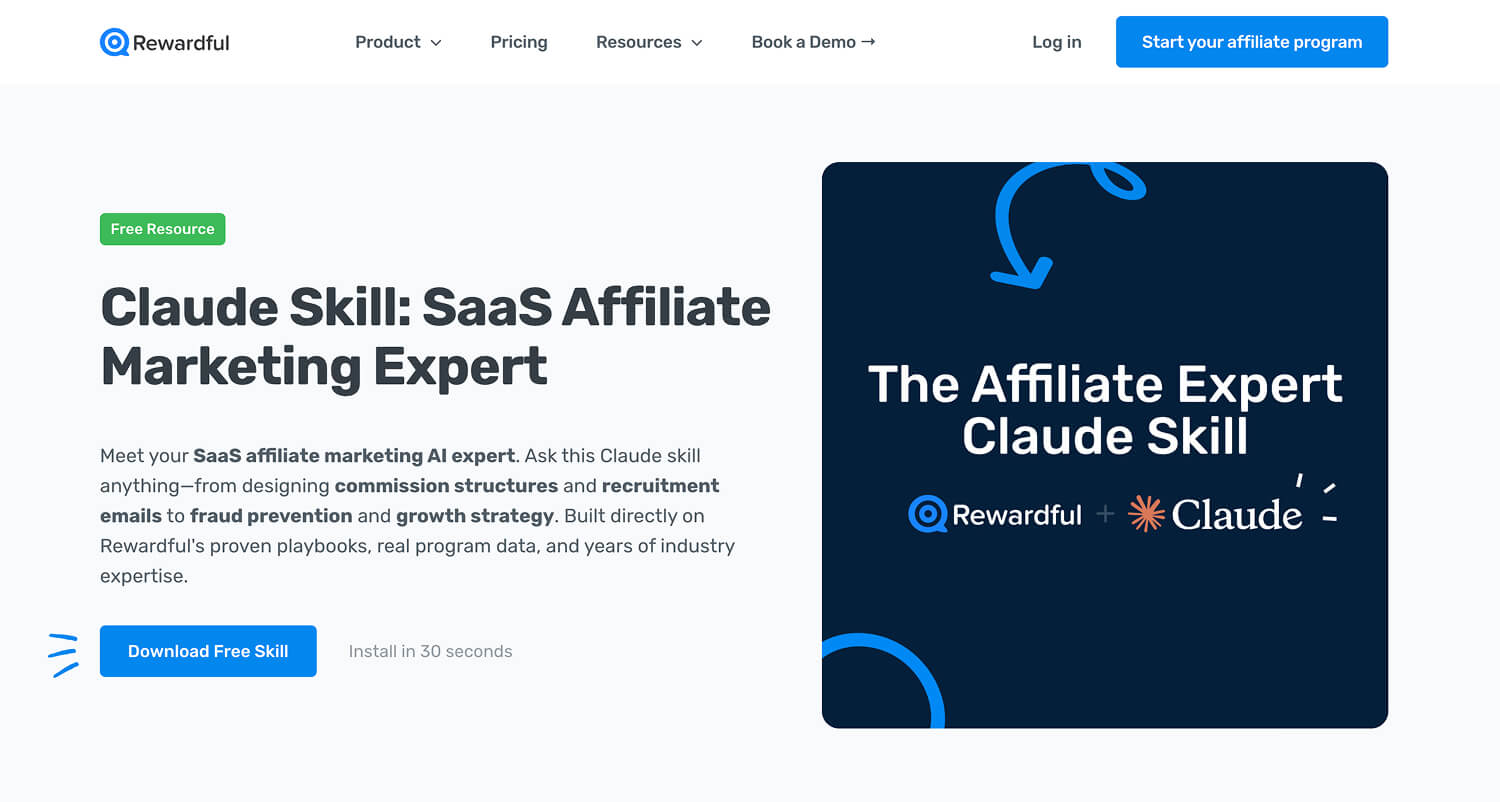
Need inspiration for what an affiliate resource library looks like when it's built to show up in AI search? Check out Rewardful's affiliate resource library. And if you want to pressure-test your brief before sending it to affiliates, Rewardful's free Claude skill gives you an always-on SaaS affiliate expert to work through it with.
3. Prioritize Affiliates Who Create Content That Compounds
A coupon page produces a traffic spike around a launch or sale, then fades. A long-form comparison article that gets cited by ChatGPT can keep producing inbound for 18 months or more, because the citation persists every time the model is asked a similar question. Same affiliate program, same commission rate — very different long-term value.
That's the case for recruiting and enabling affiliates who produce depth over volume. Not instead of your coupon affiliates, but alongside them. One well-placed review, cited once, compounds in a way that a hundred thin listicles never will.
Enable Your Affiliates to Power Your AI Visibility Strategy
The affiliate programs that will succeed in AI search over the next two years aren't necessarily the biggest or the most aggressive. They're the ones where someone decided that cite-worthy content was worth optimizing for and built the recruitment, briefing, and reward logic around that decision.
For a wider view of what's working across the industry, our State of SaaS Affiliate Programs. If you're building or rebuilding a program right now, our roundup of the best affiliate software for AI SaaS companies covers the tooling. And if you're trying to work out what to pay people for the kind of content described above, the Affiliate Commission Guide is a good starting point.
And if you're looking for a reliable SaaS affiliate management software, Rewardful is a solid option. Start a free 14-day trial — no credit card required.