Most affiliate tools for Stripe say they “integrate with Stripe.” On paper, that sounds reassuring. But there’s a significant difference between a SaaS affiliate tracking platform that simply connects to Stripe — and one that is architected around Stripe’s subscription model.
If you run a SaaS company on Stripe, billing isn’t static. Customers upgrade mid-cycle. Stripe applies proration. Refunds adjust invoice totals. Subscriptions cancel, reactivate, and retry failed payments. Stripe manages that complexity natively. Your affiliate software has to decide how it handles those changes.
This guide compares Rewardful vs. some SaaS affiliate tools that offer Stripe integration. This includes FirstPromoter, PartnerStack, and Impact. We’ll focus specifically on how each affiliate software connects with Stripe, how commission is calculated for recurring subscriptions, and where reconciliation friction can arise.
Why Choosing Affiliate Software With Seamless Stripe Integration Is Critical
Choosing the right affiliate tool for Stripe starts with understanding what Stripe integration actually is and what it isn't.
To customers, Stripe is a payment button. To SaaS, it's subscription infrastructure. It stores customer, subscription, invoice, and other payment-related information. When someone upgrades halfway through a billing cycle, Stripe recalculates the invoice and applies proration. When someone downgrades, it may generate credits. When someone cancels and later reactivates, the subscription state changes accordingly.
Stripe doesn't, however, manage affiliate attribution or commission logic. It doesn't determine which revenue is commissionable, calculate recurring payouts, or resolve referral tracking disputes. That's your affiliate tool's job, and how it connects to Stripe determines how accurately it does it.
Bidirectional vs. Unidirectional Stripe Integration for Affiliate Software
Many affiliate tools integrate with Stripe via webhooks, but they don’t connect in the same way. Some use bidirectional Stripe data sync, some use an unidirectional integration method.
Bidirectional Stripe Integration
One affiliate management tool that offers bidirectional Stripe connection is Rewardful (Rewardful calls it ‘Stripe-native integration’). Through this two-way Stripe sync interaction, Rewardful calculates commission from the final invoice amount Stripe records as paid, then writes affiliate and commission data back into Stripe metadata. Both systems stay in sync because data flows in both directions.
Unidirectional Stripe Integration
With unidirectional Stripe integration, commission logic stays inside the affiliate tool’s own data model — Stripe receives nothing back. Some affiliate software that uses unidirectional Stripe integration includes FirstPromoter, PartnerStack, and Impact—which we will discuss later.
For companies that run on stable subscription models, this works. But for SaaS businesses that rely on dynamic billing (upgrades, prorated invoices, partial refunds, reactivations), accuracy depends on every purchasing event being caught and processed correctly. Miss one, and commission totals drift from actual Stripe invoice amounts.
However, the unidirectional Stripe connection offers one advantage: platforms not tied to Stripe's architecture can support multiple billing systems. For SaaS companies that run entirely on Stripe, that flexibility can outweigh the reconciliation costs.
Note: The analysis below is based on publicly available Stripe integration documentation from each platform at the time of writing. Product capabilities, edge cases, and limitations may extend beyond what is described in help docs, and implementations can vary. If any details are outdated or incomplete, we welcome clarification.
1. Rewardful
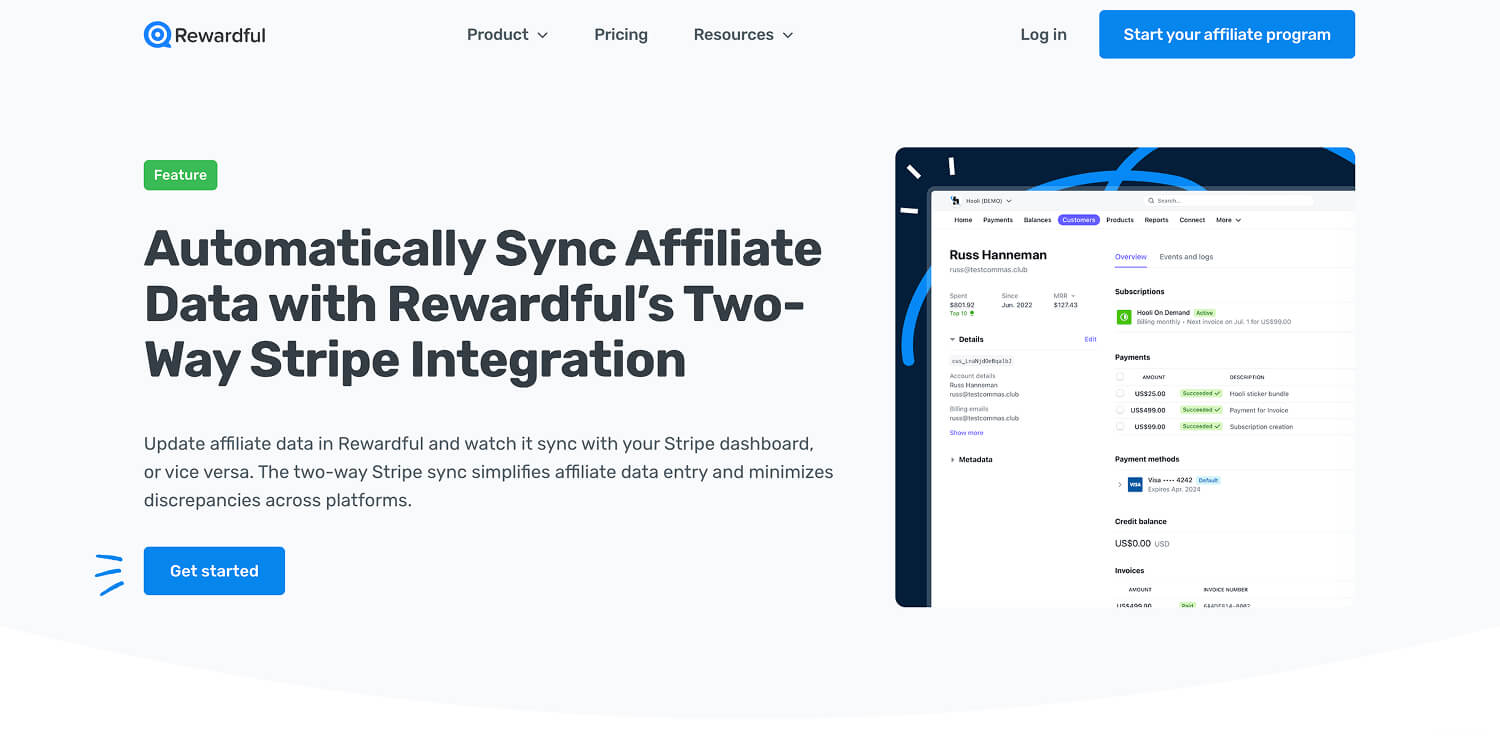
As a member of the Stripe partner program, Rewardful wasn’t retrofitted to support Stripe. It was architected for it.
Rewardful’s Two-way Stripe Sync
Here is what Rewardful's two-way sync Stripe integration looks like in real subscription workflows:
- Mid-cycle upgrade with proration
Stripe recalculates the invoice. Rewardful calculates commission from that final prorated invoice amount and updates the metadata accordingly. - Refunds and partial refunds
When a refund is issued in Stripe, Rewardful recalculates commission based on the refunded amount and updates the invoice metadata to reflect the new commission. No manual corrections needed. - Failed payments and reactivations
If a payment fails and later succeeds, recurring affiliate commission continues in line with the subscription's real status in Stripe.
See this guide to understand how Rewardful connects to your Stripe.
What Makes Rewardful’s Stripe Integration Different From Other Stripe Affiliate Tools?
With unidirectional webhook integration, commission logic lives inside the affiliate platform's own data model. Stripe doesn't receive data back. When billing events are missed or misinterpreted, commission totals drift — and that discrepancy only surfaces when finance compares Stripe exports to affiliate commission reports and finds the numbers don't match.
With Rewardful's two-way sync, that comparison is straightforward. Both reports draw from the same metadata. Revenue and commission stay aligned because they're updated together.
Also read: Best Affiliate Software with Stripe Integration in 2026
Rewardful’s One-Click Stripe Integration
Connecting Rewardful to Stripe is super easy and requires only one click. No webhook configuration. No event mapping. No engineering oversight required.
For affiliates, the downstream effect is clarity and consistency. Commission is derived directly from paid Stripe invoices, so what they see reflects real revenue, not estimates awaiting adjustment. That level of accuracy builds long-term trust in your Stripe-based affiliate program.
2. FirstPromoter

How Firstpromoter Stripe Integration Works
FirstPromoter connects to Stripe through a settings-based setup — connect your Stripe account through the integrations tab and FirstPromoter begins listening for billing events via webhooks. Full setup walkthrough in their integration documentation.
Where Firstpromoter’s Stripe Integration Accuracy Can Break Down
FirstPromoter's troubleshooting documentation flags several scenarios that may require manual cross-checking: matching customer emails, account IDs, and coupon code consistency between systems. For some subscription-based companies with many dynamic billing activities, this kind of reconciliation work can become part of normal operations rather than an occasional fix.
Who FirstPromoter Is For
For businesses with stable pricing and limited subscription changes, FirstPromoter's Stripe setup is functional and sufficient. For companies where subscription complexity is the norm, commission accuracy requires active monitoring.
3. PartnerStack
How PartnerStack Stripe Integration Works
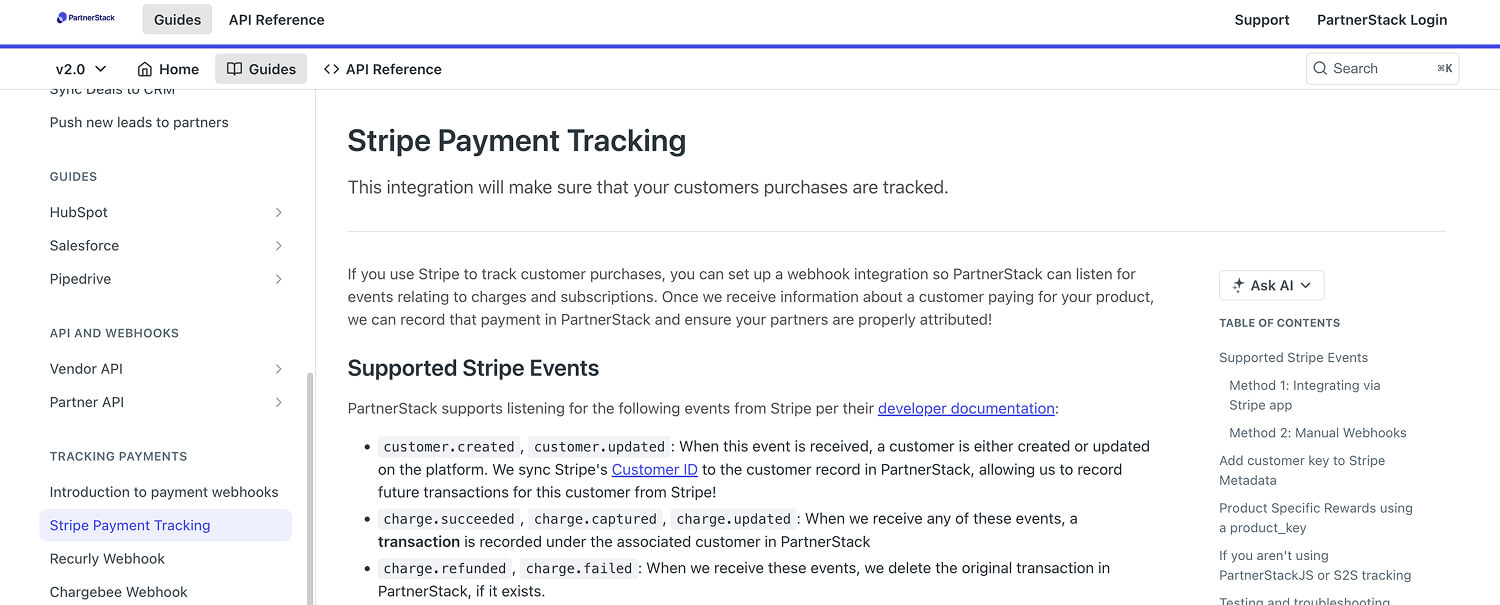
Based on their documentation, PartnerStack connects to Stripe via a webhook-based integration, with a Stripe app install as the primary setup method. Once connected, PartnerStack listens for specific Stripe events: charge completions, refunds, and invoice payments.
Where PartnerStack’s Stripe Integration Accuracy Can Break Down
PartnerStack's documentation discusses a potential troubleshooting issue: the transaction amount recorded can differ depending on which Stripe billing signal PartnerStack is configured to listen to — one pulls from the charge amount, the other from the invoice subtotal.
As on the customer matching function, by default, the Stripe App matches customers between Stripe and PartnerStack via email address. For more precise matching, PartnerStack recommends setting a unique customer key in Stripe metadata — for example, a CRM identifier — though this is optional rather than required.
Who PartnerStack Is For
Since PartnerStack supports other payment processing software besides Stripe, it is best for companies managing multiple partner types across varied billing systems. For SaaS companies running entirely on Stripe subscriptions with dynamic pricing, this versatility may not be needed.
4. Impact
How Impact Stripe Integration Works
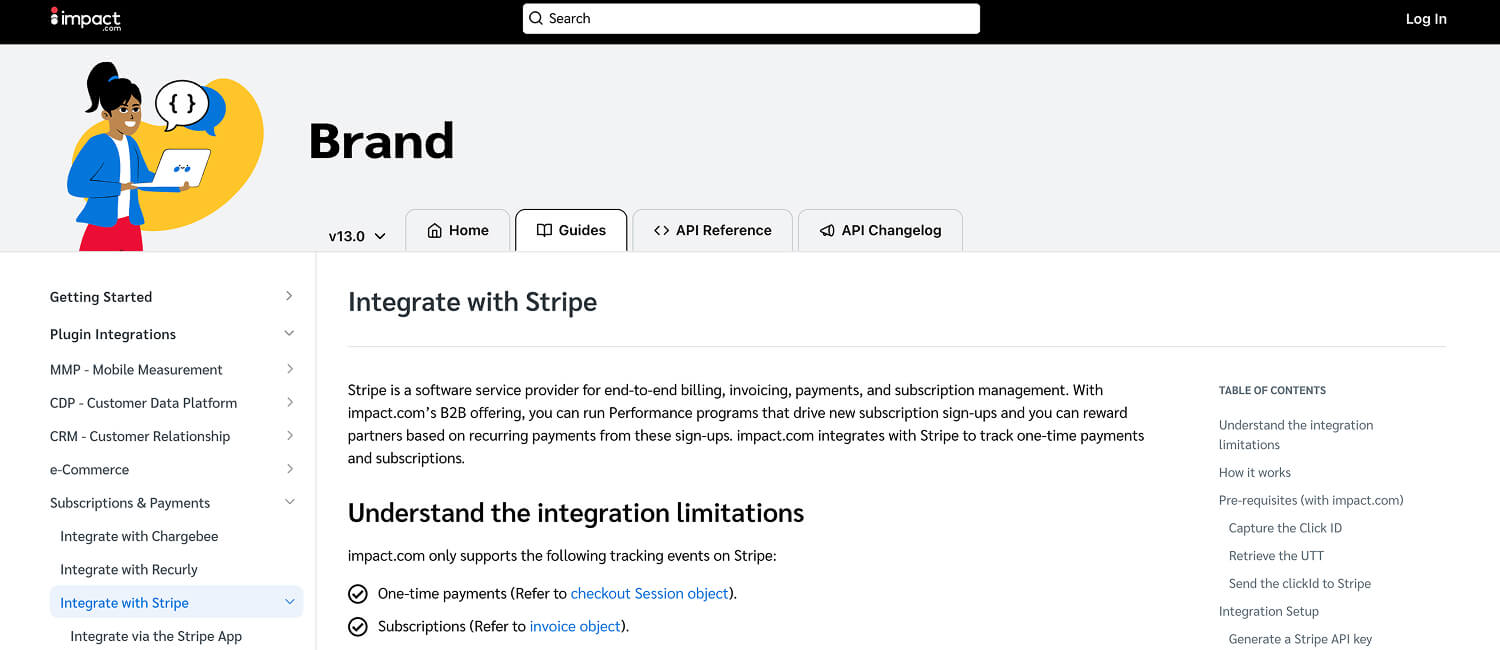
Impact connects to Stripe through an event webhook integration. Setup requires implementing Impact's Universal Tracking Tag, generating Stripe API credentials, embedding a click ID into Stripe subscription metadata via custom backend code, and configuring multiple IDs across Impact's platform. Two webhook endpoints are registered in Stripe upon setup.
Where Impact’s Stripe Integration Accuracy Can Break Down
Based on the documentation, it looks like Impact's Stripe integration tracks three billing actions only: invoice payments, one-time checkout completions, and refunds. It can distinguish a first subscription payment from a recurring one, but may not differentiate between recurring billing events beyond that. Upgrades, downgrades, and mid-cycle changes may fall outside the integration's native handling, and refunds may include a built-in 1-hour processing delay.
Who Impact Is For
For large organizations coordinating multi-channel partnership programs across varied billing environments, Impact's infrastructure suits that scope. For SaaS companies running entirely on Stripe subscriptions, the developer-intensive setup, limited supported events, and event-driven architecture can introduce operational overhead that a Stripe-native setup avoids entirely.
5 Questions to Ask to Find Your Ideal Stripe Affiliate Tool Partner
All four platforms discussed above ''work'' with Stripe. So, should you just go with your gut?
Not so fast. There are people in your team who will have an opinion on this. So before choosing a Stripe-proof affiliate software, ask internally:
1. Is Stripe our single source of truth for subscription revenue?
If you reconcile revenue directly against Stripe invoices and expect commission totals to reflect those exact numbers, a Stripe-architected solution like Rewardful keeps both systems aligned at the data level. If Stripe is only one of several billing systems feeding into a broader partner infrastructure, PartnerStack or Impact may align better with that model.
2. How dynamic is our subscription behavior?
If customers frequently upgrade mid-cycle, downgrade, receive credits, or request refunds, calculating commission directly from the final Stripe invoice amounts reduces ambiguity. That leans toward Rewardful. If your pricing model is relatively stable and subscription changes are limited, setups like FirstPromoter can function effectively.
3. How much engineering oversight are we comfortable maintaining?
Complex Stripe integrations require configuration and monitoring. If something breaks, it often becomes a technical task. If you prefer affiliate commission logic to remain tightly aligned with Stripe’s subscription objects without additional mapping layers, a Stripe-architected system reduces that operational surface area.
4. How important is reconciliation simplicity for finance?
If your finance team regularly compares Stripe revenue exports against affiliate commission totals, deriving both from the same subscription data simplifies that process. For this, Rewardful’s two-way sync with Stripe is a solid option. If affiliate commission is just one element of a larger partner expense model across multiple channels, broader platforms like PartnerStack or Impact may be appropriate.
5. Are we building a focused SaaS affiliate program or a full partnership ecosystem?
If your goal is a recurring SaaS affiliate program tightly coupled to Stripe subscriptions, depth of Stripe alignment is usually more important than cross-channel breadth. If you are orchestrating resellers, influencers, and multiple partner types across billing systems, the broader scope of Impact or PartnerStack may be necessary.
So, Which Affiliate Tool Offers the Best Stripe Integration?
The affiliate tools that offer the best Stripe integration will depend on your company’s financial activity and the payment processing software you use. Choose Rewardful if you want a two-way Stripe payment sync and one-click Stripe integration, or adopt other SaaS affiliate tools if you rely on Stripe and other payment systems.
If Stripe is your billing backbone, the closer your affiliate system sits to Stripe’s native subscription model, the less translation exists between revenue and commission.
Try Rewardful’s Seamless Stripe Integration
If you want to see what our Stripe-architected affiliate setup feels like in practice, try Rewardful for free for 14 days.
Full functionality. No credit card required. Connect your Stripe account, run it against your real subscription data, and decide based on your own experience whether Rewardful SaaS affiliate software is for you.